1868 Tumbran federal election
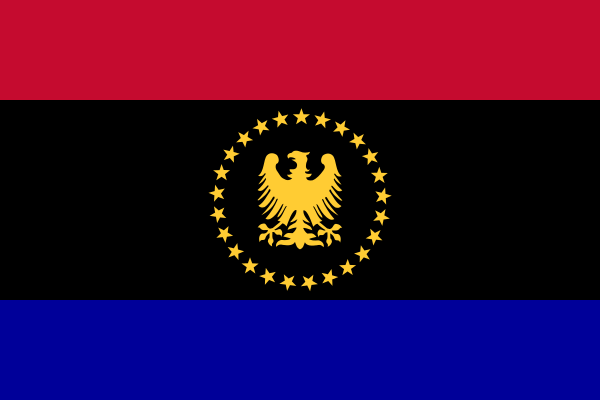 | |||||||||||||||||||||||||||||||||||||||||||||||||||||||||||||||||||||||
24 April 1868
| |||||||||||||||||||||||||||||||||||||||||||||||||||||||||||||||||||||||
All 350 seats to the Tumbran House of Representatives 176 seats needed for a majority | |||||||||||||||||||||||||||||||||||||||||||||||||||||||||||||||||||||||
|---|---|---|---|---|---|---|---|---|---|---|---|---|---|---|---|---|---|---|---|---|---|---|---|---|---|---|---|---|---|---|---|---|---|---|---|---|---|---|---|---|---|---|---|---|---|---|---|---|---|---|---|---|---|---|---|---|---|---|---|---|---|---|---|---|---|---|---|---|---|---|---|
| Registered | 13,370,463 | ||||||||||||||||||||||||||||||||||||||||||||||||||||||||||||||||||||||
| Turnout | 81.0% ( 4.0%) 4.0%) | ||||||||||||||||||||||||||||||||||||||||||||||||||||||||||||||||||||||
| |||||||||||||||||||||||||||||||||||||||||||||||||||||||||||||||||||||||
| |||||||||||||||||||||||||||||||||||||||||||||||||||||||||||||||||||||||

.png)


.jpg)
The 1868 Tumbran federal election was held on 24 April 1868 to elect the members of the 2nd House of Representatives of Tumbra. These were the first elections in Tumbran history to take place with all twenty-five states due to the merger of the Western Tumbran Republic into the Federal Republic of Tumbra early in the year. Consequently, the House of Representatives was expanded by fifty seats to allow for Western states to be properly represented. The governing Federalist Party, led by incumbent Prime Minister Richard Barker, again won a plurality of seats, but did not win an outright majority. The Federalists therefore re-entered a coalition government with the Liberals, who were led into the election by incumbent Deputy Prime Minister Alexander Henderson. This election is notable for being the only one where the True Westerners Party, a party opposed to the Western merger into Tumbra, contested. Led by former Governor of Grantfeldt Sam Richmond, the party won 28 of the 50 seats added for the seven western states.
Background
The Federalist-Liberal coalition government, which spanned ten ministries, had largely spent its term building up state institutions and managing the construction of the capital city of Straton. Outside the issue of free trade and tariffs, the coalition government was largely in agreement on most issues of policy, and both parties had come to an agreement to leave the current consensus on trade — high tariffs on nascent industries with free trade on agricultural products — untouched. The government positioned itself as a manager of business "which private interests could not stand to manage on behalf of our Nation," and was largely reluctant to interfere in the operations of the free market.
The Barker-Henderson government has been seen as a conservative government in its outlook. Fiscally, the government spent its term focusing mainly on paying off large debts that had been incurred by individual state governments during the United States era, while appropriating a new line of credit through the establishment of the First Bank of the Federal Republic. This would incur a large short-term political cost from more conservative elements of both coalition members' parties, and there was a minor split in the Federalist Party over the issue. Led by Andrew Lippincott, the short-lived Unionist Party advocated for no state-sponsored bank, arguing that it was "manifestly an appearance of government corruption in a state-sponsored corporation." However, when it became clear that the issue had no long-term impact, the Unionists merged back into the Federalists.
The government ran balanced budgets for the first two years of its term, but ran minor deficits in the third year, leading to the opposition Centre-Agrarian Party to decry the government's "profligate spending," something it would eventually use in its election campaign. The Radicals, while a minor presence in the House and which constantly struggled for attention in the government presses, said that the government's spending did not go far enough, and called for the establishment of a social security net to protect workers which had their jobs displaced by the ongoing industrialisation of the country.
The last year of the coalition government, however, would be dominated by the issue of the western merger. The Western Tumbran Republic, which had broken away from the old Empire of Tumbra and refused to join the United States of Tumbra, was now in an extremely bad financial situation and was unable to pay off its debts. Elections two years prior had given the Democratic Party supermajorities in both chambers of the Western Republic's legislature, and was widely interpreted as a mandate to negotiate to join the Federal Republic. A five-person negotiation team, comprising Barker, Henderson, Foreign Minister Henry Makepeace, Treasurer Benjamin Northcote, and Commerce Minister Elijah Short conducted negotiations, with an agreement for the Western Republic to merge into the Federal Republic on January 5, 1868. The eventual annexation was ratified via supermajority vote in both houses of the Federal Parliament in August 1867, with the three Radicals joining the government in the House vote. The Western vote fell upon similar party lines.
After the annexation vote concluded, however, it was revealed by the press that part of the conditions for the western states to only have the same amount of autonomy as the other eighteen states in the Federal Republic (as opposed to a greater amount of autonomy, which was what the Western negotiation team wished the seven states to have) was for the Federal Republic to additionally assume all debts of the Western Republic. The Centre-Agrarians latched upon the agreement, and castigated the federal government for its perceived recklessness, turning debates on the 1868 Budget into a "circus," with frequent disruptions to debates in the chamber for running a massive deficit. The Government, on the other hand, argued that the plan to unite all Tumbrans under a single flag "could not be quantified in debt and credit". Ultimately, the 1868 budget, which ran a large deficit to cover the costs of Western integration, was agreed to on a party-line vote.
In the West, those who were vehemently opposed to annexation gathered under the banner of the True Westerners Party. Angry that their seven states had not been given a higher level of autonomy as the eighteen eastern states, they decried the merger negotiations as one of a betrayal of Western identity. Led by the last Governor of Grantfeldt, Sam Richmond, the True Westerners would argue for the general concept of "Western autonomy" in the Federal Republic, but offered little concrete proposals on how said autonomy would be obtained, and had few proposals otherwise. Still, the anger felt in the west was enough to give the party enough support to worry those in Straton that the merger would be short-lived.
Campaign
While publicly accepting that their parties were going to contest against each other, Barker and Henderson spent the last few months before the election campaign planning how best to ensure that either one of their parties would win the election. Sensing widespread antipathy toward the Federalist brand in the west of the country, Barker essentially conceded the seven western states to Henderson's Liberals by not fielding any Federalist candidates in any of the fifty new seats. This, while seen as a short-term tactical plan to deny the True Westerners representation by consolidating the pro-merger vote, would eventually be the first step to giving the Liberals a virtual stranglehold over the region for the next hundred years. The Liberals briefly considered spinning off their western branches into a satellite party, adopting the Unionist name that had briefly surfaced in Tumbran politics a few years earlier, but eventually decided to contest in the western states under their official name.
The Federalists would concentrate their campaign resources in the east of the country, campaigning on the government's achievements over the last four years while running defence on the government's fiscal record, promising that a return to sound financial management would occur in the second term of any Federalist or Federalist-led government. Arguments to national unity with regards to the annexation of the Western Tumbran Republic were popular, and largely offset any anger in the east about the perception of the high cost of the merger. The Liberals, meanwhile, contested less vigorously in the east, while focusing most of its resources in the west. Liberal leader Alexander Henderson essentially campaigned exclusively in the south-west, promising that the Liberals were best-placed to give the Southwest a voice. An endorsement from the last President of the Western Republic, Anthony Yardley, essentially solidified Southwestern support for the Liberals, considering that the Southwest had also been the most eager to join the Federal Republic.
The Centre-Agrarian Party sought to shore up their coalition of agrarians and centrists by appealing to the urban poor, which had voted for the Federalists in huge numbers and which helped them come out on top against the Liberals in 1868. It held high hopes of displacing the Liberals as the second-largest party in the population-rich north-east. They fielded candidates in all of the western seats, and actively campaigned in the region. However, it adapted its campaign message for the region, campaigning on increased devolution for the region and targeting its urban regions, instead of accusing the incumbent government of financial profligacy.
The True Westerners, given the advantage of being able to concentrate their campaign resources exclusively on the West, saw a speaking tour by Sam Richmond across metropolitan areas in the region. Richmond was able to effectively marshal western anger, particularly in the more affluent northwest, and while he never called for re-independence, several candidates run by the party explicitly endorsed the idea of Western re-independence, or if the Southwest was unwilling to leave the Federal Republic, at least a secession of the three northwestern states of Grantfeldt, Marlsbruhe, and Caduke. The idea generated controversy in the southwest, which subsequently closed ranks around the Liberals.
The Radicals stuck largely to their hyper-local campaigns. Still largely a southeastern-based party, the party only fielded 24 candidates — an increase of five from the last election — but welcomed and endorsed independent candidates who wished to run under the Radical banner. Thirteen such candidates were endorsed in this way. The cause of the Radicals was boosted by the explicit endorsement of Gerald Evander Gerritsen, who stumped for the Radicals on the campaign trail, now that he was not running for the nonpartisan office of President.
Results and aftermath
Results
| Party | Leader | Seats | Change | Votes | % | Change | |
|---|---|---|---|---|---|---|---|
| Federalist | Richard Barker | 139 | 6
|
3,828,155 | 35.33 | Decrease7.38% | |
| Centre-Agrarian | Samuel Lightfoot | 106 | 6
|
3,544,267 | 32.71 | 0.84%
| |
| Liberal | Alexander Henderson | 74 | 10
|
2,601,585 | 24.01 | Decrease0.10% | |
| True Westerners | Sam Richmond | 28 | 28
|
677,214 | 6.25 | 6.25%
| |
| Radical | David Sheares | 3 | - | 184,202 | 1.70 | 0.39%
| |
| Total | 350 | 10,835,423 | |||||
In the east, the results were largely a re-run of the 1864 election, with the Federalists' electoral coalition remaining largely intact, picking up some seats from the Centre-Agrarians over tactical voting from Liberal voters, who had been implicitly encouraged to vote Federalist in seats where the race was between Federalists and Liberals.The Liberals lost twelve of their fifty-two seats in the east, but this was made up for by their twenty-two new seats in the west, and the party maintained their stranglehold on the twelve university seats. Eastern Liberals were still extremely disappointed by the results, and accused Henderson of abandoning them and the cause of free trade. The backlash was thought to be one reason why Henderson voluntarily stepped down as leader in 1870, faced with a loss in support from the remaining eastern Liberals. The Federalists, due to their decision to forgo contesting in the west of the country, saw a severe dip in their popular vote percentage, even if the total number of raw votes they won increased from 1864.
In the west, meanwhile, the decision of the Federalists to step aside from contesting seats there was widely deemed to have saved the merger of the west into the east. While the True Westerners won twenty-eight of the region's fifty seats, the Liberals won more seats than the True Westerners in five of the seven states. The True Westerners swept all fourteen of Grantfeldt's seats and won seven of Marlsbruhe's twelve seats, but only won six of the twenty seats on offer in the south-west. While Richmond alleged electoral fraud caused by voters being transported from the east of the country to the west, no such evidence was found.
The Centre-Agrarians, who had been hoping for major gains, would be disappointed; while they gained six seats overall, and made minor gains in the most populated states of Napier, Bechor, and Georgia, they failed to make headways against the government. The party won over seven hundred thousand votes nationwide from the last election, but that was largely due to the party fielding an additional fifty candidates in the West, none of whom won any seats. The presence of the Centre-Agrarians also served as a spoiler candidate in many Western seats, with around seven seats won by the Liberals that would have been otherwise won by the True Westerners without a Centre-Agrarian candidate. While this served to prove an initial stumbling block for relations between the two parties, both parties were soon convinced that working together was the only way to provide a unified opposition to the Liberals in the west, and the True Westerners merged into the Centre-Agrarians six months after the election.
With no party winning a majority of seats, the Federalist-Liberal coalition was re-constituted along the same balance of Cabinet departments as in the first government. Richard Barker was re-elected as Prime Minister, with Alexander Henderson as Deputy Prime Minister; the Federalists and Liberals split the cabinet departments six to two again, with the Liberals holding the Foreign Affairs and Navy portfolios. An additional ministry being created to manage Western integration into the country, known as the Ministry of Western Affairs. Out of deference to the Liberals' strong position in the region, they were given control of this additional ministry; they chose to appoint the last President of the Western Republic, Anthony Yardley, to the position. Yardley had been appointed as a Senator for the state of Lormark following the election, and joined the Liberal Party upon his ascension to Cabinet.
Results by state
| State | Federalist | Liberal | Centre-Agrarian | True Westerners | Radical | Total |
|---|---|---|---|---|---|---|
| Alexandria | 10 | 1 | 11 | |||
| Bencoolen | 2 | 3 | 5 | |||
| Georgia | 13 | 1 | 11 | 25 | ||
| Keybrook | 4 | 8 | 12 | |||
| Raleigh | 2 | 4 | 6 | |||
| Thornton | 4 | 7 | 11 | |||
| Bechor | 21 | 9 | 14 | 44 | ||
| Finnley | 10 | 4 | 2 | 16 | ||
| Harren | 3 | 1 | 4 | |||
| Marcato | 11 | 1 | 1 | 13 | ||
| Napier | 28 | 10 | 15 | 53 | ||
| Straton | 3 | 2 | 1 | 6 | ||
| Caduke | 3 | 1 | 4 | |||
| Grantfeldt | 14 | 14 | ||||
| Marlsbruhe | 5 | 7 | 12 | |||
| Clearmont | 9 | 3 | 11 | 2 | 25 | |
| Dartmoor | 5 | 6 | 11 | |||
| Severn | 6 | 5 | 8 | 1 | 20 | |
| Fremont | 6 | 2 | 8 | |||
| Lormark | 3 | 2 | 5 | |||
| Pesvern | 2 | 1 | 3 | |||
| Turvenal | 3 | 1 | 4 | |||
| Gamaliel | 3 | 3 | ||||
| Iswilyn | 4 | 7 | 11 | |||
| Westmond | 4 | 1 | 7 | 12 | ||
| Universities | 12 | 12 | ||||
| Total | 139 | 74 | 106 | 28 | 3 | 350 |