Flag of Omerica
 | |
| Name | Sublime Union |
|---|---|
| Use | National flag File:FIAV 111000.svgFile:FIAV normal.svg |
| Proportion | 1:2 |
| Design | A blue field charged with a symmetric white-edged red cross between four gold fleurs-de-lis |
 Variant flag of Omerica | |
| Use | Civil ensign File:FIAV 000100.svgFile:FIAV normal.svg |
| Proportion | 1:2 |
| Design | A red field with the Sublime Union in the canton |
 Variant flag of Omerica | |
| Use | State ensign File:FIAV 000010.svgFile:FIAV normal.svg |
| Proportion | 1:2 |
| Design | A blue field with the Sublime Union in the canton |
 Variant flag of Omerica | |
| Use | Naval ensign File:FIAV 000001.svgFile:FIAV normal.svg |
| Proportion | 1:2 |
| Design | A white field with the Sublime Union in the canton and a blue eight-pointed star in the fly |
The flag of Omerica (French: drapeau de l'Omerique), known domestically as the Sublime Union, is the national flag of the United Republics of Omerica. It is a heraldic banner of arms, with a design corresponding exactly to that of the shield in the coat of arms. The flag and arms are officially defined by the National Symbols Act (French: Loi sur les symboles nationaux), which specifies the blazon of the arms as "Azure, a cross gules fimbriated argent between four fleurs-de-lis Or".
Symbolism
The design of the Sublime Union is based on the attributed arms of Bricius, the legendary King of All the Omerike in Omerican folklore, and combines symbols associated with anglophone and gallophone Omericans. The central cross combines the Cross of Saint Michel with the Cross of Saint George and is combined with four fleurs-de-lis from the legendary banner of Gallia Moderne.
In a historic context, the petals of the fleurs-de-lis represented the mediaeval estates: the clergy, the nobility and the commoners; since the abolition of the monarchy, the fleurs-de-lis have been re-interpreted to represent growth and prosperity and the petals to represent the three Omerican Revolutionary Wars: the War of the Succession, the War of Independence and the Civil War.
Design
Specification
The Omerican flag is usually half as tall as it is wide, though flags with a 2:3 or 3:5 ratio can also occasionally be seen. For aesthetic reasons, flags that have the Omerican flag in the canton (particularly the ensigns and war flags) should always be 1:2 to preserve the square fly area, with the canton being half of both the length and width to the upper hoist (left) quarter.
Unlike the coat of arms, for which any depiction that accords with its blazon is considered legally correct, the exact dimensions for the elements of the flag are specified in the National Symbols Act. The thickness of the central red cross and white fimbriation are specified as being 1⁄5 and 1⁄15 of the length of the flag's short edge respectively, regardless of the flag's ratio or orientation. The fleurs-de-lis are centred in each blue quadrant and have a width and height equal to 1⁄6 and 5⁄24 of the flag's height respectively.
Colours
The colours of the flag were not standardised at its adoption and thus varied from one to the next. A corporate design was laid down by ordinance in 1988 and modified in 2015 to accommodate electronic display.
| Scheme[a] | Royal blue[1] | Red[2] | White | Yellow[3] |
|---|---|---|---|---|
| Pantone | 287 C | 704 C | Safe | 109 C |
| CMYK | 100.75.2.18 | 8.97.76.31 | 0.0.0.0 | 0.9.100.0 |
| RGB | (0,48,135) | (158,42,47) | (255,255,255) | (255,209,0) |
| HEX | #003087 | #9E2A2F | #FFFFFF | #FFD100 |
Use
Protocol
Custom states that the national flag should be displayed in a dignified and honourable manner and should be lowered at night unless properly illuminated. The flag should never be allowed to touch the ground or water, be used as a drapery or hold anything before unfurling. No other flag may fly higher than the national flag by law; the flag should occupy the place of honour under Omerican law and should be the first flag raised and last lowered. Displaying a frayed or dirty flag is considered insulting; flags that are unfit for continued use are traditionally burnt in private as a mark of honour.
Consistent with the honour and dignity of the flag, it should never be dipped to a person or thing. The flag should be hoisted and lowered to the tune of the national anthem and all persons present should face the flag and stand at attention, while those in uniform should render a salute. During a period of national mourning, the flag may be flown at half-staff by raising the flag to the top of the flagpole and immediately lowering it a third of the way down, a process which is reversed when the flag is lowered from the pole; if flying the flag at half staff is not possible or practicable, a black ribbon may be attached to the top of the pole above the flag. At state or military funerals, the flag may be draped over the coffin with the fleurs-de-lis pointing toward the right shoulder of the deceased; the flag is removed before the coffin lowered into the grave or cremated and folded up and presented to the next of kin as a token of respect.
Related flags
-
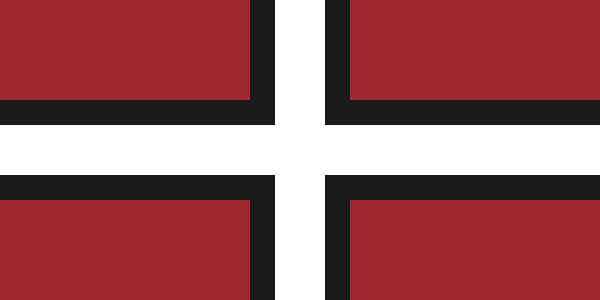
Flag of Alleos
-
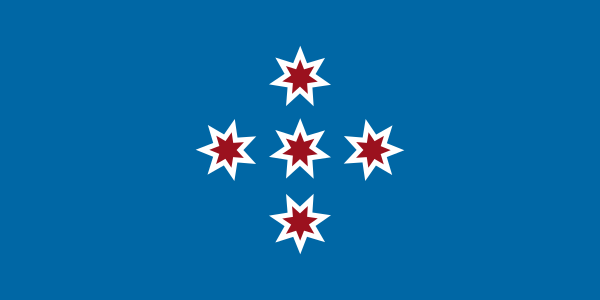
Flag of Altomare
-
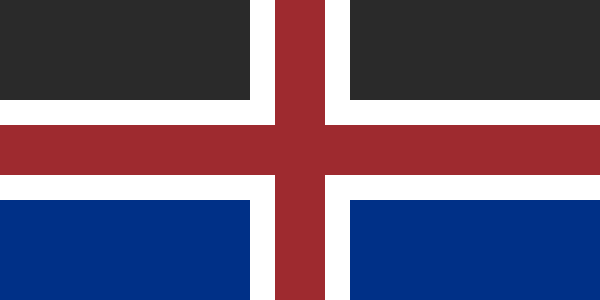
Flag of Charlescourt
-
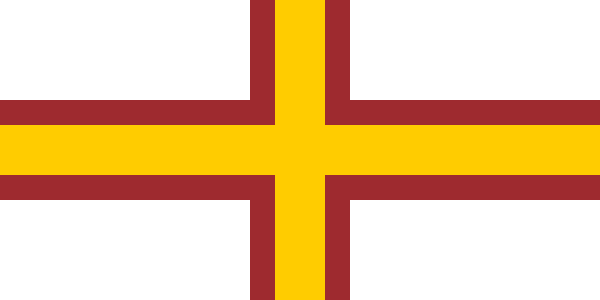
Flag of Cinnabar Island
-
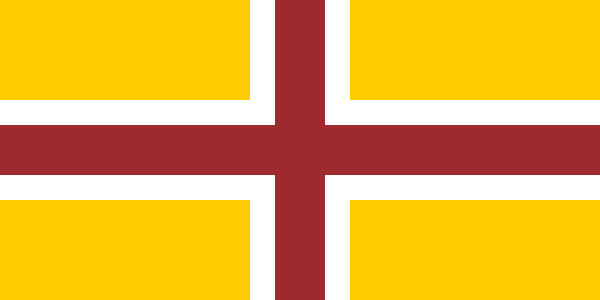
Flag of Coleraine
-
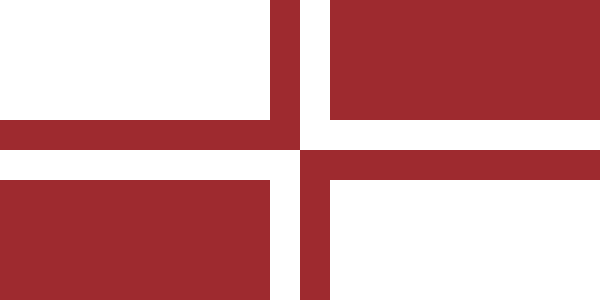
Flag of Port-des-Saints


See also
Notes
- ↑ All HEX, CMYK and RGB specifications for the Pantone colours are taken from the official Pantone website on the webpages of the corresponding colours. Although the colour schemes are official, they are not completely congruent. This is due to different specifications for different types of media (for example, screen and print).
Citations
- ↑ PANTONE. "PANTONE 287 C - find a PANTONE Color". www.pantone.com. Retrieved 8 June 2018.
- ↑ PANTONE. "PANTONE 704 C - find a PANTONE Color". www.pantone.com. Retrieved 8 June 2018.
- ↑ PANTONE. "PANTONE 109 C - find a PANTONE Color". www.pantone.com. Retrieved 8 June 2018.