Starblaydia national football team
| Nickname(s) | Officially none |
|---|---|
| Association | Starblaydi Football Association |
| Confederation | AOCAF (Atlantian Oceania) |
| Other affiliations | |
| Head coach | Ázëwyn Fëanáro (WC78-Present) |
| Captain | Cosmo Leopoldi (WC86) |
| Team Records | |
| Most caps | Ázëwyn Fëanáro (270) |
| Top scorer | Valrauncion (116) |
| KPB ranking | |
| Current | 9th |
| Highest | 1st (WC30-31, WC47-48) |
| Lowest | 169th (World Cup 60) |
| First international | |
 Vilita 2 - 1 Starblaydia Vilita 2 - 1 Starblaydia  | |
| Biggest win | |
Starblaydia 9 - 0 Kosovoe  | |
| Biggest defeat | |
Starblaydia 1 - 7 Valanora  | |
| World Cup | |
| Entered | 67 (First in World Cup 15) |
| Finals Apps | 52 (First in World Cup 17) |
| Best result | Champions, 5 times |
| AOCAF Cup | |
| Appearances | 56 (first in AOCAF Cup 2) |
| Best result | Champions, 7 times |
The Starblaydia national football team represents Starblaydia in international football competitions such as the World Cup and the Atlantian Oceania Confederation of Association Football Cup (AOCAF Cup). It is controlled by the Starblaydi Football Association (SFA), the governing body for football in the nation.
Starblaydia have competed on the world stage for almost three centuries and are among the most successful World Cup nations of all time, having won a joint-record five World Cup titles. They have won a total of eighteen tournament championships at senior level, which also includes six championships at AOCAF Cup level, an Olympic gold medal and three other minor tournament wins. Twelve of these are classed as 'major' championships (defined as the three WCC-endorsed tournaments and four recognised regional competitions), which is more than any other nation in history. Starblaydia are ranked third on the all-time list of footballing nations, as measured by the Spaam Ranking System, and were inducted into the World Cup Nation Hall of Fame after World Cup 27. To date, twenty-four Starblaydi players have been entered into the World Cup Hall of Fame.
History
The Beginning
Starblaydia began their quest for international footballing dominance in World Cup 15. They missed out on the opportunity to take part in the Baptism of Fire, but the strength of their Under-21 program meant they entered their first Qualifying campaign ranked 115th in the world. Their first match was a loss against region-mates Vilita, who have been Starblaydia's rivals ever since, and they also managed a shock 5-1 victory over the top-16 side Dance 2 revolution. Starblaydia qualified for their first World Cup eight years later in World Cup 17, making a dream run through to the Quarter Finals. They also began entering the AOCAF Cup, winning their first international trophy on home soil in the 4th edition. Starblaydia continued to qualify for the World Cup before they co-hosted the 20th World Cup with Druida. They went on to win three more regional titles and an Under-21 World Cup in the build-up to World Cup 25, where Starblaydia took their first Championship in Kaza, Kaze Progressa, denying Rejistania a fifth title. This was Starblaydia's first 'Double' of holding World and Regional championships at the same time, and marked the culmination of the 'Golden Generation of Starblaydi football', so named for a group of players who won the Under-21 World Cup before going on to become World Champions at senior level. This group of players was led by central defender Nunzio Gre, who had captained both trophy-winning teams. After a number of deep knockout stage runs in tournaments, Starblaydia cemented their place as one of the world's greats in World Cup 28 with a second championship, denying Bedistan a third consecutive Championship. They also won the 14th AOCAF Cup immediately after, repeating their 'Double' achievement and becoming the number-one team ranked team in the world as well as in the region of sporting superpowers, Atlantian Oceania. Starblaydia added to their tournament victories by won the Olympic Gold for Men's Football and continued to qualify for the World Cup, reaching the final again in World Cup 30, until a government-imposed exile after World Cup 34.
The Second Stint
Returning in World Cup 38 after a change of government, Starblaydia were Runners-Up in their Baptism of Fire, losing out to The Pazhujeb Islands, and quickly worked their way back up the rankings. They qualified for the very next World Cup, then immediately co-hosted World Cup 40 with Krytenia (for a time known as West Starblaydia), making history by becoming the first nation to host the Baptism of Fire, World Cup and Cup of Harmony for the same edition as part of the 'XL' Bid (also known as the 'Überbid'). In the following tournament, a Starblaydi side ranked 22nd in the world not only incredibly took the World Championship, but then won the Atlantian Oceania title again barely a year later, for their third 'Double', propelling them back into the top ten of the world as well as into the record books.
After Valanora won back-to-back championships, Starblaydia once more reigned supreme in the World Cup, halting a Vanorian 'three-peat' and taking a fourth world title in the 44th edition of the Cup. This drew Starblaydia level with Rejistania and Bedistan as the most decorated World Cup teams ever. They were also back at the top table of the KPB ranking system, looking to be crowned as the best team in the world for the first time in a generation, which was achieved when the finals of World Cup 47 began. Starblaydia went on to win a historic and record-setting fifth world title in that tournament, defeating host nation Valanora on their home ground in the final in what was considered a match for the ages. The team would not be able to replicate these heroics again, although later on did win the Under-21 World Cup for the second time. Despite this, however, the strength of Starblaydi football began to wane.
Part Three: #wewantsix
After a second hiatus from the 58th to 60th Cups, Starblaydia returned to the international game without fanfare or championship success. Despite an extreme underdog run to the final in World Cup 63, where they were defeated by debut winners Audioslavia, Starblaydia was no longer a great team on the world stage. World Cup 67 saw their last successful qualifying campaign, failing to make it to the Cup proper all the way up to World Cup 77 and the disastrous AOCAF 53 that followed it. Administrators at the Starblaydi Football Association instigated a new strategy to return to the top of the game, known as '#wewantsix'. Under the new management of elven legend Ázëwyn Fëanáro, they once more set the World Championship as their aim and began the long climb to the top, qualifying for World Cup 78 onwards, reaching the World Cup 83 Final and winning the 61st AOCAF Cup. Starblaydia continued to rise up the rankings with each tournament to once more count themselves among the best sides in the world once more.
Team Culture
Uniforms and Crest
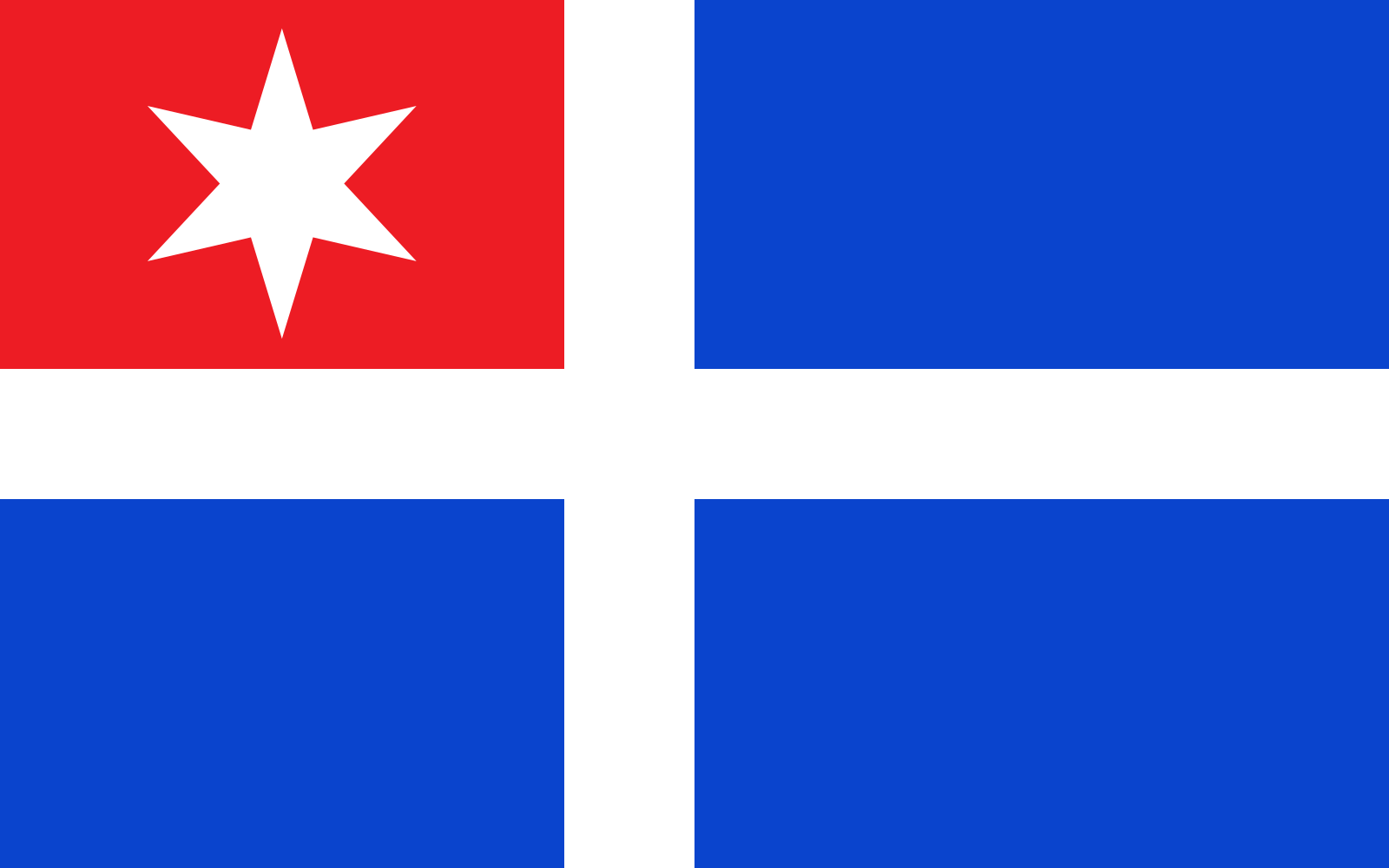
Starblaydia have always worn white shirts, shorts and socks with purple trim since their inception. Their away kit is traditionally a reverse of this, with purple shirts, shorts and socks with white trim, and it is from this kit that some of Starblaydia's unofficial nicknames come: Men in Mauve and Purple Peril. Other away kits worn by Starblaydia - particularly in the more minor tournaments away from the World Cup and AOCAF Cup - have included kits containing mostly yellow, gold, green, bronze or black. The distinctive purple colour of Starblaydi kits is drawn from the national flag, which in turn derives its purple from the Starblaydi Orchid, the national flower.
The Starblaydi sportswear company Ediraf have always provided the kits for Starblaydia's team, from their very first outings debuted at World Cup 15 and have created five distinct generations of Starblaydi kits, each improving technically and aesthetically upon the last.
World Cup 40's black kit was the first and subsequently only time Starblaydia had not worn a white home kit, due to the death of Simeone Di Bradini. As a special edition for World Cup 41, both home and away kits had their purple replaced by green as part of a nation-wide environmental campaign, 'Green Starblaydia'. From World Cup 42 onwards three gold stars, one for each world championship, were added above the symbol of the SFA. This then grew to four stars after the record-equaling fourth world championship in World Cup 44, and twelve years later an unprecedented fifth star added above the SFA logo with the historic victory in World Cup 47.
Rivalries
With nearly three centuries of history to draw upon, Starblaydia have had many rivalries over the years. The most important current rivalries to Starblaydi fans are:
- The Bekkside Derby with one-time AOCAF Cup Champion Krytenia, who are located across the great Lake Bekk in Calania.
- The tussle for world domination with five-time World Champions Valanora, starting in the 40s of the World Cup.
- The series with Atlantian Oceania's founder nation and five-time World Champions Vilita, who have traded wins in matches with Starblaydia regularly ever since World Cup 15.
- The North-East Calanian Derby with two-time World Champions Audioslavia.
Historically, Starblaydia have also considered themselves rivals with:
- Four-time World Champions Bedistan, having faced them in World Cup 28 and 30's finals, winning one each.
- Four-time World Champions Rejistania, who Starblaydia defeated to take their first World Championship.
- Three time Atlantian Oceania Champions Lamoni, before they moved to Greater Dienstad.
- One-time World and Regional Champions Sarzonia, a bitter rivalry both on and off the pitch.
- Two-time World Champions Liventia/Liverpool England, who formed the top 3 teams in the World in the late 20s of the World Cup along with Starblaydia and Bedistan.
Squad Numbers
The structure of the shirt numbering system for players of the Starblaydia national football team comes from a time long before Starblaydia began playing in international competitions such as the World Cup and AOCAF Cup. The numbering system is not unique to Starblaydia, as similar variations of it developed both independently of and in conjunction with Starblaydi footballing culture. For Starblaydi players and fans, squad numbers - particularly the starting eleven - are traditionally associated with a certain position, but there are no set rules. This has been a part of Starblaydi football since it first began, and the team has kept to their tradition of numbering players from 1 to 11 (12 and upwards for substitutes) for every tournament.
Formation
Starblaydia traditionally line up in a 4-4-2 'Diamond' Formation. This style provides a strong defensive benefit, with two central defenders, two full-backs and a 'holding' midfielder to act as fifth defensive player. The team often uses this defensive midfielder - usually wearing the number 4 shirt - as a fulcrum, turning defence into attack, and letting the two wide midfielders, the central attacking midfielder and two strikers charge forward. Full backs are a key positions as they must be versatile to defend, bolster the midfield and provide extra attacking options, but most importantly, they provide the width. With the right players, this an adaptable formation suitable to most situations.
Style of play
Starblaydi teams tend to value energy, passion, determination, skill and fair play. Each player must be willing to put his, or her, body on the line and give their very soul to the team. Starblaydia's national motto is, after all, translated as "Honour, Glory, Blood". Every player must display a good work ethic, a desire to win and, most important of all, talent. Starblaydi teams generally tackle hard, but fair, and interchange excellent passing and teamwork with individual brilliance. Though a solid defence - particularly the back four - is the bedrock of the success, Starblaydi teams can never be said to be defensive-minded.
As Starblaydia tend to play the same formation from tournament to tournament (see 'Formation' section above), every position on the pitch is highly valued for its overall contribution to the team. The striker cannot score if he has not received the ball from a supporting midfielder, who must receive it from a defender, who in turn only has the ball because the team's goalkeeper protected the net. Teamwork qualities are always stressed by coaching staff at the national level, cultivating a 'Starblaydia F.C' environment, as if the national side was a club team.
Sportsmanship
A key pillar of behaviour in Starblaydia is fairness, which extends through the entire culture to include football. Starblaydi players, in general, do not dive for free kicks, badger the referee or commit dirty or 'gamesmanship' fouls and any such play by their opponents draws anger and disbelief. Penalties and other fouls will, of course, be claimed when a player genuinely feels they have been committed, but Starblaydi players are not the type to pick up their feet and fall to the floor as if they've been shot by a sniper when an opponent brushes against them. Any players who perform such theatrics are generally condemned as cheaters. Club managers are known for fining and dropping players for blatant dives in previous matches, and the Starblaydi Football Association has the power to fine and retrospectively award yellow cards (and any subsequent fines/suspensions if a certain amount of yellow cards have been received) to players based on video evidence. The SFA, clubs and football society in general is determined to stamp out any cheating in Starblaydia's national game.
Captains
To be made the captain of the national team, the one who wears the armband and leads the country on the field, is one of the most honoured achievements any Starblaydi footballer can attain. In Liga Starblaydia, the captain is the only player permitted to speak with the referee regarding their decisions without being spoken to first, and often a referee will call the captains over to discuss a disciplinary decision over a bad tackle, fight, etc. In the international scene, however, this rarely happens, and the captain's role is far less tangible. A Starblaydi captain is expected to lead by example, to be a paradigm of Starblaydia's style of play and sportsmanship (see above). They are the players to look for in any desperate situation, as they will be trying the hardest to turn the match in Starblaydia's favour.
The Raiigar
The Raiigar is a tribal dance designed to ready its performers for a challenge ahead, originally danced by an ancient Starblaydi tribe before battle. It was recreated and first used from the fifth and final First Group Stage match against Mallatarsland in the Baptism of Fire for World Cup 38 and became a new cultural tradition for the team to enact before each match, after the national anthems of both teams have been played, but prior to the kick-off. It is designed, in the words of its re-creator Lex Panarii, to show that "your songs are stronger and your feet are faster" than those of your opposition. It has also been described as "both awe inspiring and terrifying" by an observer from Rennidan who was not even facing the dance and "intimidating and ferocious" by players from Zwangzug who faced it in World Cup 39. Similar in nature to the Ariddian Ulek the first clash of these two ancient dances in the opening qualifying match of World Cup 38 produced 'one of the most memorable moments in the history of world football' as the two dances were performed simultaneously.
Supporters
Ordinary Starblaydi football fans have always followed their team with passion, songs and support across the entire world. Even in the very beginning, against Vilita in World Cup 15, Starblaydia filled their seating allocation and have maintained incredible levels of support throughout the years.
Fans of the team will often be seen wearing patriotic white and purple coloured clothing or replica shirts, carrying banners and occasionally musical instruments. Though a liberal sprinkling of alcohol is always nearby, Starblaydi fans are on the whole respectful and well-behaved whether at home or away.
Starblaydi fans are also known for their songs and chanting throughout matches, directed at players, staff, officials, other fans and even the occasional celebrity. From the simplest, repetitive mob-chanting of "Star-blade-yer, Star-blade-yer, Star-blade-yer!", through player-specific chants like "Ooh, aah, Tumunzahar! Say ooh-aah Tumunzahar!", up to hymns "Away in Krytenia, no Creds for a bed, little Lord Tiberius sat up and he said, 'Star-blade-yer! Star-blade-yer! Star-blade-yer!" and mockery of regional events with "Who's that drowning by the pool side, who's that lying in the sun?". All these, of course, are in addition to standard chants and songs sung by many teams across the world.
Crunching tackles, swift counter-attacks, skilled play - particularly if it makes a fool of an opposing player - and incredible saves are most likely, apart from goals, to get a Starblaydi fan off their seat and applauding. No matter the player, or the situation, however, if a player in a Starblaydi shirt has tried their utmost and given everything for the team's cause - whatever the outcome - Starblaydi fans will always show them respect and gratitude.
Home Stadium
The national team plays its home games at the environmentally-friendly 196,754-seater Stadii Di Bradini stadium. It was first used for the final of the 6th Di Bradini Cup. Before this, up to World Cup 42, Starblaydia did not have a single 'national stadium' like many other nations, instead the national team took on the role of a traveling circus and toured the nation's primary stadia to bring the team to all parts of the country for home matches.
When rotating around Starblaydi cities, Jhanna United's Jader Barbahlo stadium was previously the largest on the Starblaydi mainland, seating 96,000 fans, however the 99,000 capacity Stadii di Quercus on the island of Aquiliana, home to FC Farça, eventually overtook it as the primary home venue in terms of ticket sales. The main Stadia in the cities of Jhanna, Tabeck, Corinth, Vecchio and Penningworth also played regular host to the national team, but these stadiums now host non-Final matches in international tournaments such as the Di Bradini Cup.
The site of the 80th World Cup Final, all of Starblaydia's home matches now take place in the Stadii Di Bradini, close to the popular tourist destination of Downtown Jhanna, Starblaydia's capital city. Boasting extensive transport links, hotels, restaurants, bars, clubs and entertainment, the Downtown area is the perfect place for a nearly quarter of a million fans to disperse into every evening after a match. It also has a direct route to JAX, Starblaydia's main internal airport and a major air travel hub of Atlantian Oceania.
The stadium is named after Starblaydia's most legendary former player, Jhanna-born striker Simeone Di Bradini: the former World Cup Committee President, World Cup Hall of Famer, and four-time World Cup Winner (all with The Holy Empire as player/manager), for whom the Di Bradini Cup, the world's premier Under-21 tournament, is also named. It is a gargantuan stadium notable for environmentally friendly 'eco-stadium' features built-in since before ground was first broken on the site. Designed and constructed using as many recyclable materials and installed with technology that reduce its carbon footprint and lowers its energy needs, the exterior features a huge array of photovoltaic solar panels on the roof. It was the centrepiece of the 'Green Starblaydia' project many years ago and remains one of the world's iconic stadiums.
Media Coverage
Domestically all Starblaydia matches are screened live on SCB:Sports, the primary sports broadcaster in the nation, which extends to live streaming online for Starblaydi-based users only. Commentary is broadcast live across digital radio and online streaming, extending the live coverage yet further. Extensive newspaper coverage, both in print and online versions, is available throughout Starblaydia, as well as internationally where foreign versions of Starblaydi newspapers are distributed, primarily from the Jhanna Chronicle and Daily Llama.
Unlike many other nations, Starblaydi media does not generally try to knock the national team's players just for the sake of a good story; Starblaydi fans are usually very knowledgeable about the game and would see through unwarranted and undeserved criticism of a Starblaydi player.
Coaching Staff
Ázëwyn Fëanáro (270 Caps, 71 Goals), an elf who is over 4,050 years old, scored the winner in the 47th Final against Valanora, denying them a title on their own turf and lifting Starblaydia to the mantle of all-time greatest team. Known for her excellent attacking play, range of passing and great eye for goal that lifts her to second in the all-time goalscorers list too, by virtue of a nearly 1-in-4 ratio, Ázëwyn Fëanáro is a symbol of grace, power and beauty from Starblaydia's golden age, some hundred and twenty-five years ago when the Cup was in its 40s. It is these qualities that the SFA managed to recapture with Fëanáro at the helm, bringing her trademark poise and piercing yell to the touchlines after more than a decade of national failures. She took her team to four consecutive World Cups immediately upon taking charge, improving on their results each time, and finishing 3rd in the 56th AOCAF Cup, Starblaydia's best tournament result in 70 years.
Jerzy Makuszewski, in his 60s, is Fëanáro's Assistant Manager, a former Starblaydi international goalkeeper who made 83 appearances. Known as "Chef" by those who can pronounce his surname correctly, Makuszewski took up the mantle of the "Best in the World" goalie Lucas Cable to become Starblaydia's unassailable number one between the posts and also wore the captain's armband. Always a fiery character, he can shift from jovial to furious in moments, and is Fëanáro's 'enforcer', barking out orders and remonstrating with players and officials with equal fervour.
Players
For each tournament, be it World Cup, AOCAF or any of a myriad of different competitions, Starblaydia's Manager (occasionally called a Head Coach), will pick a squad of twenty-three players, from which the 'Starting Eleven' will receive the shirt numbers One to Eleven. The other twelve, termed 'Substitutes' or 'Reserves', are handed the remaining numbers up to Twenty-Three. These twelve players are used for in-game tactical substitutions, to prepare for any injuries and suspensions suffered by the team, or to give younger players some experience of major tournaments in preparation for the future.
Current Squad
|
Starblaydia squad - World Cup 86 Qualifiers |
|
|---|---|---|
|
1 Leopoldi (c) | 2 Galdarhim | 3 Wolffe | 4 Kranendonk | 5 Conway | 6 Renatovic | 7 Shepherd | 8 Maddison | 9 Roshanak | 10 Jetvanna | 11 Jimenez | 12 Vadaparthy | 13 Hoyt | 14 Hoyt | 15 Royce | 16 Saraviva | 17 Velasquez | 18 Al Qubaisi | 19 Narvaez | 20 Lamont | 21 Bernini | 22 Ortiz | 23 Damocles | Coach: Fëanáro | ||
Competitive Record
WC statistics updated to World Cup 86 Qualifying
Overall
| Total record - all matches | ||||||
|---|---|---|---|---|---|---|
| Competition | Pld | W | D | L | GF | GA |
| World Cup Finals | 228 | 110 | 43 | 75 | 406 | 327 |
| World Cup Qualifying | 984 | 655 | 173 | 156 | 2267 | 1013 |
| AOCAF Cup | 353 | 215 | 63 | 75 | 766 | 436 |
| Other Tournaments | 297 | 146 | 50 | 101 | 613 | 354 |
| Total | 1862 | 1126 | 329 | 407 | 4052 | 2130 |
World Cup
| World Cup Finals record | World Cup Qualification record | Manager | |||||||||||||||
|---|---|---|---|---|---|---|---|---|---|---|---|---|---|---|---|---|---|
| Edition | Round | Pld | W | D* | L | GF | GA | Pld | W | D | L | GF | GA | ||||
 World Cup 1 to World Cup 1 to   World Cup 14 World Cup 14
|
Did not enter | Did not enter | No Manager | ||||||||||||||
  World Cup 15 World Cup 15
|
Did not qualify | 18 | 6 | 6 | 6 | 31 | 26 | Georges-Ringeaux | |||||||||
  World Cup 16 World Cup 16
|
Did not qualify | 10 | 2 | 5 | 3 | 13 | 15 | Georges-Ringeaux | |||||||||
 World Cup 17 World Cup 17
|
Quarter-Finals | 3 | 2 | 0 | 3 | 6 | 5 | 15 | 9 | 3 | 3 | 31 | 14 | N'Dumbu-Nsungu | |||
 World Cup 18 World Cup 18
|
Group Stage | 3 | 2 | 0 | 3 | 6 | 5 | 15 | 9 | 3 | 3 | 28 | 16 | N'Dumbu-Nsungu | |||
  World Cup 19 World Cup 19
|
Group Stage | 3 | 2 | 0 | 3 | 6 | 5 | 14 | 9 | 2 | 3 | 31 | 14 | N'Dumbu-Nsungu | |||
 World Cup 20 World Cup 20
|
2nd Round | 4 | 2 | 1 | 1 | 9 | 4 | Qualified as Co-hosts | N'Dumbu-Nsungu | ||||||||
  World Cup 21 World Cup 21
|
Group Stage | 3 | 0 | 2 | 1 | 5 | 7 | 12 | 8 | 3 | 3 | 28 | 16 | N'Dumbu-Nsungu | |||
  World Cup 22 World Cup 22
|
2nd Round | 4 | 2 | 1 | 1 | 3 | 2 | 10 | 9 | 1 | 0 | 22 | 4 | Van Honjiik & Lazerevski | |||
| World Cup 23
|
Quarter-Finals | 5 | 3 | 0 | 2 | 6 | 5 | 14 | 12 | 1 | 1 | 28 | 3 | Lazerevski | |||
 World Cup 24 World Cup 24
|
Group Stage | 3 | 1 | 1 | 1 | 4 | 5 | 14 | 10 | 4 | 0 | 33 | 11 | Lazerevski | |||
 World Cup 25 World Cup 25
|
Champions | 7 | 5 | 1 | 1 | 13 | 7 | 18 | 13 | 3 | 2 | 34 | 15 | Lazerevski | |||
  World Cup 26 World Cup 26
|
2nd Round | 4 | 1 | 1 | 2 | 8 | 9 | 12 | 9 | 3 | 0 | 29 | 12 | Azanulbizarn | |||
 World Cup 27 World Cup 27
|
3rd Place | 7 | 5 | 0 | 2 | 16 | 8 | 16 | 13 | 1 | 2 | 58 | 10 | Azanulbizarn | |||
  World Cup 28 World Cup 28
|
Champions | 7 | 5 | 1 | 1 | 13 | 6 | 12 | 11 | 0 | 1 | 26 | 6 | Azanulbizarn | |||
 World Cup 29 World Cup 29
|
Quarter-Finals | 5 | 4 | 0 | 1 | 15 | 5 | 14 | 13 | 1 | 0 | 44 | 5 | Azanulbizarn | |||
  World Cup 30 World Cup 30
|
Runners-up | 7 | 6 | 0 | 1 | 14 | 7 | 14 | 14 | 0 | 0 | 45 | 4 | Azanulbizarn | |||
 World Cup 31 World Cup 31
|
Quarter-Finals | 5 | 3 | 0 | 2 | 13 | 7 | 18 | 13 | 2 | 3 | 50 | 19 | Oberlander | |||
  World Cup 32 World Cup 32
|
2nd Round | 4 | 3 | 0 | 1 | 9 | 7 | 16 | 12 | 4 | 0 | 46 | 11 | Oberlander | |||
  World Cup 33 World Cup 33
|
Group Stage | 3 | 0 | 0 | 3 | 1 | 9 | 18 | 10 | 2 | 6 | 51 | 25 | Oberlander | |||
 World Cup 34 World Cup 34
|
Group Stage | 3 | 0 | 0 | 3 | 2 | 6 | 12 | 6 | 5 | 1 | 25 | 14 | Oberlander | |||
 World Cup 35 to World Cup 35 to   World Cup 37 World Cup 37
|
Did not enter | Did not enter | No Manager | ||||||||||||||
  World Cup 38 World Cup 38
|
Did not qualify | 14 | 4 | 1 | 9 | 17 | 23 | Marrones | |||||||||
 World Cup 39 World Cup 39
|
Quarter-Finals | 5 | 2 | 1 | 2 | 7 | 12 | 14 | 4 | 1 | 9 | 17 | 23 | Marrones | |||
| World Cup 40
|
Group Stage | 3 | 1 | 0 | 2 | 3 | 7 | Qualified as co-hosts | Marrones | ||||||||
 World Cup 41 World Cup 41
|
Champions | 7 | 4 | 3 | 0 | 13 | 9 | 12 | 6 | 2 | 2 | 20 | 12 | Panarii | |||
  World Cup 42 World Cup 42
|
2nd Round | 4 | 2 | 0 | 2 | 10 | 7 | 12 | 9 | 3 | 0 | 33 | 10 | Panarii | |||
| World Cup 43
|
Quarter-Finals | 5 | 3 | 1 | 2 | 7 | 6 | 14 | 11 | 1 | 2 | 31 | 11 | Panarii | |||
 World Cup 44 World Cup 44
|
Champions | 7 | 6 | 1 | 0 | 17 | 7 | 14 | 9 | 2 | 3 | 21 | 8 | Panarii | |||
 World Cup 45 World Cup 45
|
Quarter-Finals | 5 | 2 | 2 | 1 | 11 | 11 | 14 | 12 | 2 | 0 | 30 | 5 | Panarii | |||
 World Cup 46 World Cup 46
|
Quarter-Finals | 5 | 4 | 0 | 1 | 7 | 5 | 10 | 7 | 2 | 1 | 22 | 11 | Drakkiborgo | |||
| World Cup 47
|
Champions | 7 | 6 | 1 | 0 | 22 | 8 | 13 | 12 | 1 | 1 | 45 | 7 | Drakkiborgo | |||
| World Cup 48
|
2nd Round | 4 | 2 | 0 | 2 | 5 | 5 | 14 | 11 | 3 | 0 | 33 | 11 | Drakkiborgo | |||
  World Cup 49 World Cup 49
|
2nd Round | 4 | 1 | 1 | 2 | 10 | 7 | 16 | 13 | 2 | 1 | 42 | 14 | Drakkiborgo | |||
| World Cup 50
|
Group Stage | 3 | 1 | 0 | 2 | 6 | 2 | 20 | 13 | 4 | 3 | 62 | 25 | Kuu | |||
 World Cup 51 World Cup 51
|
Group Stage | 3 | 1 | 0 | 2 | 4 | 9 | 18 | 11 | 4 | 3 | 43 | 26 | Kuu | |||
 World Cup 52 World Cup 52
|
Group Stage | 3 | 1 | 1 | 1 | 4 | 3 | 22 | 18 | 2 | 2 | 54 | 23 | Martinez | |||
  World Cup 53 World Cup 53
|
Quarter-Finals | 5 | 1 | 2 | 2 | 7 | 6 | 18 | 14 | 3 | 1 | 40 | 13 | Martinez | |||
 World Cup 54 World Cup 54
|
Quarter-Finals | 5 | 3 | 0 | 2 | 9 | 7 | 15 | 11 | 1 | 3 | 29 | 10 | Martinez | |||
  World Cup 55 World Cup 55
|
2nd Round | 5 | 2 | 2 | 1 | 10 | 8 | 20 | 13 | 6 | 1 | 38 | 8 | Martinez | |||
 World Cup 56 World Cup 56
|
Group Stage | 3 | 1 | 0 | 2 | 6 | 7 | 14 | 12 | 1 | 1 | 34 | 6 | Roshanak | |||
 World Cup 57 World Cup 57
|
Did not qualify | 16 | 9 | 5 | 2 | 25 | 11 | Roshanak | |||||||||
  World Cup 58 to World Cup 58 to  World Cup 60 World Cup 60
|
Did not enter | Did not enter | No Manager | ||||||||||||||
| World Cup 61
|
Group Stage | 3 | 0 | 2 | 1 | 2 | 2 | 17 | 10 | 2 | 5 | 32 | 21 | Fr. Juan | |||
  World Cup 62 World Cup 62
|
Group Stage | 3 | 0 | 1 | 2 | 1 | 6 | 15 | 10 | 1 | 4 | 25 | 18 | Fr. Juan | |||
| World Cup 63
|
Runners-up | 7 | 4 | 2 | 1 | 11 | 7 | 20 | 11 | 5 | 4 | 49 | 28 | Kintz | |||
 World Cup 64 World Cup 64
|
2nd Round | 4 | 2 | 2 | 0 | 7 | 5 | 18 | 14 | 4 | 0 | 48 | 22 | Kintz | |||
| World Cup 65
|
2nd Round | 4 | 2 | 0 | 2 | 10 | 13 | 20 | 14 | 5 | 1 | 46 | 18 | Kintz | |||
 World Cup 66 World Cup 66
|
Did not qualify | 17 | 10 | 2 | 5 | 32 | 21 | Kintz | |||||||||
 World Cup 67 World Cup 67
|
2nd Round | 4 | 3 | 0 | 1 | 9 | 6 | 10 | 7 | 2 | 1 | 29 | 15 | Blassii | |||
 World Cup 68 World Cup 68
|
Did not qualify | 18 | 10 | 6 | 2 | 34 | 17 | Blassii | |||||||||
 World Cup 69 World Cup 69
|
Did not qualify | 15 | 9 | 3 | 3 | 30 | 14 | Blassii | |||||||||
 World Cup 70 World Cup 70
|
Did not qualify | 18 | 11 | 2 | 5 | 28 | 23 | Kochanska | |||||||||
  World Cup 71 World Cup 71
|
Did not qualify | 18 | 10 | 0 | 8 | 31 | 18 | Kochanska | |||||||||
| World Cup 72
|
Did not qualify | 14 | 3 | 7 | 4 | 11 | 17 | Kochanska | |||||||||
 World Cup 73 World Cup 73
|
Group Stage | 3 | 0 | 2 | 1 | 7 | 8 | 12 | 11 | 0 | 1 | 26 | 6 | Cable | |||
 World Cup 74 World Cup 74
|
Did not qualify | 12 | 7 | 2 | 3 | 21 | 9 | Cable | |||||||||
| World Cup 75
|
Did not qualify | 16 | 6 | 4 | 6 | 28 | 26 | Cable | |||||||||
  World Cup 76 World Cup 76
|
Did not qualify | 12 | 7 | 4 | 1 | 26 | 7 | Cable | |||||||||
| World Cup 77
|
Did not qualify | 18 | 13 | 1 | 4 | 29 | 14 | Cable | |||||||||
  World Cup 78 World Cup 78
|
Group Stage | 3 | 0 | 1 | 2 | 0 | 3 | 16 | 10 | 2 | 4 | 42 | 23 | Fëanáro | |||
 World Cup 79 World Cup 79
|
2nd Round | 4 | 1 | 2 | 1 | 2 | 3 | 18 | 11 | 3 | 4 | 42 | 26 | Fëanáro | |||
| World Cup 80
|
2nd Round | 4 | 2 | 1 | 1 | 13 | 9 | Qualified as co-hosts | Fëanáro | ||||||||
 World Cup 81 World Cup 81
|
Group Stage | 3 | 1 | 0 | 2 | 6 | 8 | 18 | 14 | 3 | 1 | 44 | 23 | Fëanáro | |||
| World Cup 82
|
Quarter-Finals | 5 | 3 | 0 | 2 | 8 | 5 | 18 | 10 | 5 | 3 | 54 | 30 | Fëanáro | |||
| World Cup 83
|
Runners-Up | 7 | 3 | 2 | 2 | 16 | 15 | 9 | 7 | 1 | 1 | 35 | 20 | Fëanáro | |||
 World Cup 84 World Cup 84
|
Quarter-Finals | 5 | 3 | 1 | 1 | 8 | 5 | 20 | 16 | 3 | 1 | 67 | 25 | Fëanáro | |||
  World Cup 85 World Cup 85
|
2nd Round | 4 | 2 | 1 | 1 | 7 | 6 | 24 | 15 | 5 | 4 | 78 | 46 | Fëanáro | |||
| World Cup 86
|
Quarter-Finals | 5 | 3 | 2 | 0 | 8 | 4 | 18 | 14 | 3 | 1 | 57 | 29 | Fëanáro | |||
| Total | - | 233 | 113 | 45 | 75 | 414 | 331 | 984 | 655 | 173 | 156 | 2267 | 1013 | ||||
Honours
World Cup
Champions: 2014, 2026, 2078, 2090 & 2102
Runners-Up: 2034, 2166 & 2246
Third Place: 2022
AOCAF Cup
Champions: 1986, 1998, 2002, 2010, 2026, 2077 & 2256
Runners-Up: 1982, 1994, 2084, 2091 & 2120
Third Place: 2018, 2030, 2038, 2074, 2095 & 2236
Baptism of Fire
Runners-Up: 2065
Other Championships
Four Nations Invitational 2: 1998
Men's Gold Medallists, Ashton Olympic Games, Casari: 2032
Indigenous World Cup: 2045
Kings Cup: 2103
World Cup Hall of Fame
The Starblaydi section of the World Cup Hall of Fame contains twenty-seven names, inducted in eleven separate ceremonies between World Cup 21 and World Cup 86. Five entries have been gained from World Cup Championships, thirteen from Finals appearances and nine from Qualifying campaigns.